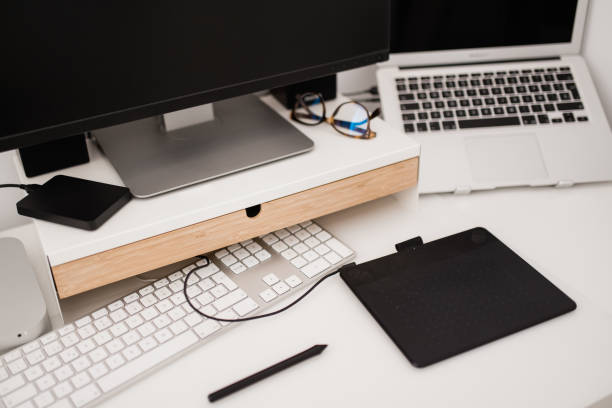
Long computer sessions do not have to end with a stiff neck, aching wrists, and a lower back that feels like it aged ten years. Most of the time, the problem is not that you are weak or fragile. The problem is that your desk is arranged like a puzzle missing a few pieces. You can fix a lot of it without buying a fancy chair or a standing desk. You just need to make your setup fit your body instead of forcing your body to fit your setup.
Start with your feet and chair. Plant your feet on the floor. If they dangle, use a box, a stack of books, or a cheap footrest. Your knees should be around hip height, and your seat should support your thighs without digging into the back of your knees. Sit back into the chair. If the chair has no lower back support, roll up a towel and place it behind your lower back. Slouching is often just your body hunting for support. Give it some.
Next, deal with your screen. The top of your monitor should be at or slightly below eye level, about an arm’s length away. If you use a laptop all day, you are probably looking down like you are reading a paperback on your lap. That is a neck problem waiting to happen. Raise the laptop on a stand, a box, or a stack of books, then use an external keyboard and mouse. Your neck will thank you within a day.
Your keyboard and mouse matter more than most people think. Keep your elbows near ninety degrees and your shoulders relaxed. The keyboard should be close enough that you are not reaching forward. Your wrists should stay neutral, not bent up, down, or sideways. A wrist rest is for resting between bursts of typing, not for typing on. Keep your mouse close to the keyboard. If you have to stretch your arm to reach it, your shoulder will complain. If your wrist hurts, try a vertical mouse or a different keyboard angle, but try free fixes first.
Here is the part people miss: perfect posture does not exist. Your body is built to move. Sitting like a statue in the “right” position for four hours is still a bad idea. Change positions every twenty or thirty minutes. Shift forward, lean back, cross your ankles, uncross them. Look at something twenty feet away for twenty seconds. Stand up and roll your shoulders. A tiny break every half hour beats a heroic stretch once a day.
Try a simple twenty-minute reset. Stand up. Take a sip of water. Look out a window. Adjust one thing about your setup. Maybe your monitor drifted closer. Maybe your chair rolled back. Maybe your mouse cable is tugging. These small corrections keep you from slowly folding into a pretzel.
Lighting and temperature are part of ergonomics too. Do not put a bright window or a harsh overhead light behind your monitor. Use softer light around the screen so your eyes are not fighting glare. Cold hands make every mouse movement feel clumsy, so keep the room comfortable or keep a hoodie nearby. Hydration matters more than energy drinks. A little fresh air can reset your brain faster than another cup of coffee.
If you game or create content for hours, think about your input devices. A mechanical keyboard is not automatically better. A quiet low-profile keyboard may suit you fine. A split keyboard can help if your shoulders roll inward. A controller can save your wrists during long sessions. The best device is the one that lets you work without pain, not the one with the most lights.
Do not ignore your eyes and ears. Headphones that clamp too hard cause headaches. Earbuds that jam into your ears for six hours get sore. Lower the volume. Blink. If you squint, get your eyes checked. Headaches are not a normal cost of being productive.
Finally, build movement snacks into your day. Turn your head left and right. Circle your shoulders. Stretch your fingers. Stand up during loading screens or between calls. If pain lasts for days or shoots down your arm, see a professional. Ergonomics reduces strain, but it is not a cure for everything.
The best setup is not the most expensive one. It is the one you will actually adjust. Raise the laptop, bring the mouse closer, support your feet, soften the light, and move more often. Your body is not asking for perfection. It is asking for support and variety. Give it both, and long sessions can feel a lot less like a slow breakdown and a lot more like second nature.