Gaming keyboards are sold with noise. Flashing lights, aggressive angles, and names that sound like spaceships. Under all that, a keyboard is a tool for sending keystrokes. The best one feels good under your fingers, fits your desk, and does not make you fight it. You do not need to be technical to choose well. Just learn which specs change your experience and which are marketing garnish.
The first big fork is membrane versus mechanical. Membrane keyboards use a rubber dome under each key. They are quiet, cheap, and fine for casual games. Mechanical keyboards use a physical switch under each key. That switch gives a more consistent press, usually lasts longer, and can be replaced on hot-swappable models. Mechanical does not make you instantly better. It gives repeatable feedback, so your brain learns exactly when a key registers. For fast movement, consistency matters more than raw speed.
Mechanical switches come in three broad flavors. Linear switches, often red, travel straight down with no bump. They are smooth and popular for competitive play. Tactile switches, often brown, have a small bump you feel when the key activates. They help avoid accidental presses and work well for gaming plus typing. Clicky switches, often blue, have a bump and a loud click. They feel great to some people and annoying to everyone in the room. If you share space, skip clicky. Magnetic hall-effect boards can set the actuation point and use rapid trigger, which resets the key the instant you release it. That can help competitive shooters, but is not required.
Layout matters more than most buyers expect. Full-size boards include a number pad, which is great for spreadsheets but eats desk space. Tenkeyless drops the number pad and gives your mouse more room. A 75 percent board keeps the function row and arrow keys in a compact frame. A 65 percent keeps arrows but often loses the function row. A 60 percent cuts nearly everything except the main keys. For most gamers, a tenkeyless or 75 percent board is the sweet spot. Hot-swappable sockets are a huge plus because you can change switches later without soldering. Keycaps matter, but less than switch feel.
For gaming, connection is simple. Wired is the safest. A 2.4 GHz wireless dongle is also excellent and often indistinguishable from wired. Bluetooth is fine for casual use but can add latency and wake-up delay. Polling rate is how often the keyboard reports to the computer. A 1000 Hz polling rate is plenty for almost everyone. Higher rates like 4000 Hz or 8000 Hz are diminishing returns. N-key rollover and anti-ghosting matter if you press many keys at once. Battery life on wireless boards varies wildly.
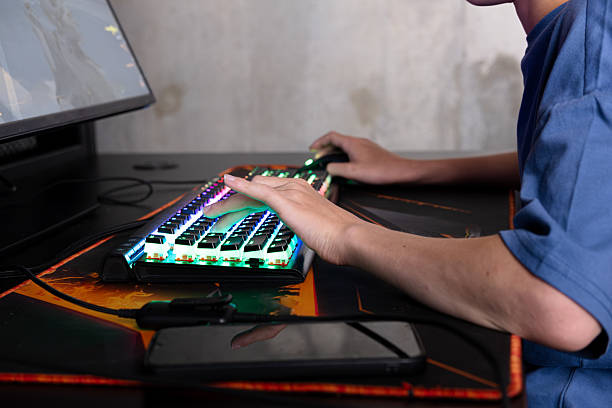
RGB lighting is optional. It will not improve aim. Macro keys, volume knobs, and media controls can be genuinely useful. Software is where brands often stumble. Some apps are bloated and need an account. Others let you save profiles onboard, so your settings travel with the keyboard. Open-source firmware like QMK and VIA is a nerdy bonus, but non-technical users can ignore it. Buy from a place with easy returns, because switch feel is personal. A switch tester or a local store can save you from a bad purchase.
Comfort and posture beat any spec. Keep your elbows near ninety degrees, wrists straight, and shoulders relaxed. A wrist rest can help, but it should support the heel of your hand, not press into your wrist. Some people prefer a slight negative tilt, meaning the back of the keyboard is lower than the front. Do not spend two hundred dollars on your first mechanical keyboard. A solid fifty to one hundred dollar board with the right layout and switch type will teach you what you like. You can upgrade later.
The real trick is to ignore marketing and focus on what you touch and feel: switch type, layout, and build quality. A good gaming keyboard disappears under your hands. It does not make you a pro, but it removes excuses and makes every session more comfortable. Pick a size that fits your desk, a switch that matches your noise tolerance, and a board that feels solid. That is a better edge than another rainbow light show.